

Most advice about Dubai trading licence costs starts with a single number. That is usually the wrong place to begin.
A Dubai trade licence is not a fixed-price product sitting on a shelf. It is a business structure built around choices mainland or free zone, trading or services, one visa or several, flexi-desk or full office, local UAE sales or international operations. If you only ask “How much does it cost?”, the answer is often incomplete because it leaves out the expensive parts.
This is where many founders get caught off guard. They compare a simple government licence fee against a full setup proposal, assume one of them is overpriced, and miss the fact that both figures can be correct. The licence itself is only one layer. The permissions and infrastructure required to actually operate the company are another.
Why “What’s the Cost?” Is the Wrong First Question
A better starting point is this: what business rights does your company need to operate properly?
A founder selling products directly in the UAE market needs a different setup from a consultant serving overseas clients. A general trading company importing goods, handling customs, and hiring multiple employees will have a very different cost structure from a solo digital business.
Treating both setups as if they carry the same Dubai trading licence cost often leads to poor decisions before incorporation even begins.
Cost Follows Strategy
In reality, the final cost is the result of your business strategy.
Authorities assess your activity type, legal structure, office requirements, and immigration footprint. After that, banks, landlords, and counterparties also assess whether your company setup matches what you actually plan to do.
If it does not, the “cheaper” setup can quickly become the more expensive mistake.
A simple rule: if a setup looks unusually cheap, check what has been excluded. In many cases, those missing items are visas, office space, additional activity approvals, or operational steps required after the licence is issued.
This is also why founders often get confused. Official government pricing may only show the licence issuance fee, while business setup consultants usually quote the broader all-in cost including the mandatory items needed to make the business functional.
Both numbers may be correct. They are simply describing different parts of the same process.
One Number Is Not Enough to Compare
The smarter way to compare Dubai trading licence costs is by splitting the budget into three parts:
Licence issuance
The authority fee for the legal permission to operate.
Activation costs
The expenses needed to make the company usable, including visas, immigration file setup, and office or workspace requirements.
Ongoing operating costs
The recurring expenses required to keep the company compliant and active each year.
What does not work is comparing only brochure pricing.
That often leads founders into the wrong jurisdiction, where they later spend more on office upgrades, activity amendments, access limitations, or delays in banking.
The cheapest licence is not always the cheapest business.
If you want an accurate cost estimate, the budget should be built around market access, staffing plans, and compliance requirements. That is how experienced advisors price a setup properly and how founders avoid expensive mistakes.
Breaking Down the Dubai Trading Licence Cost
The easiest way to understand Dubai trading licence cost is to think of it like constructing a building.
The licence itself is only one piece. You still need the structure around it before the business can operate effectively.
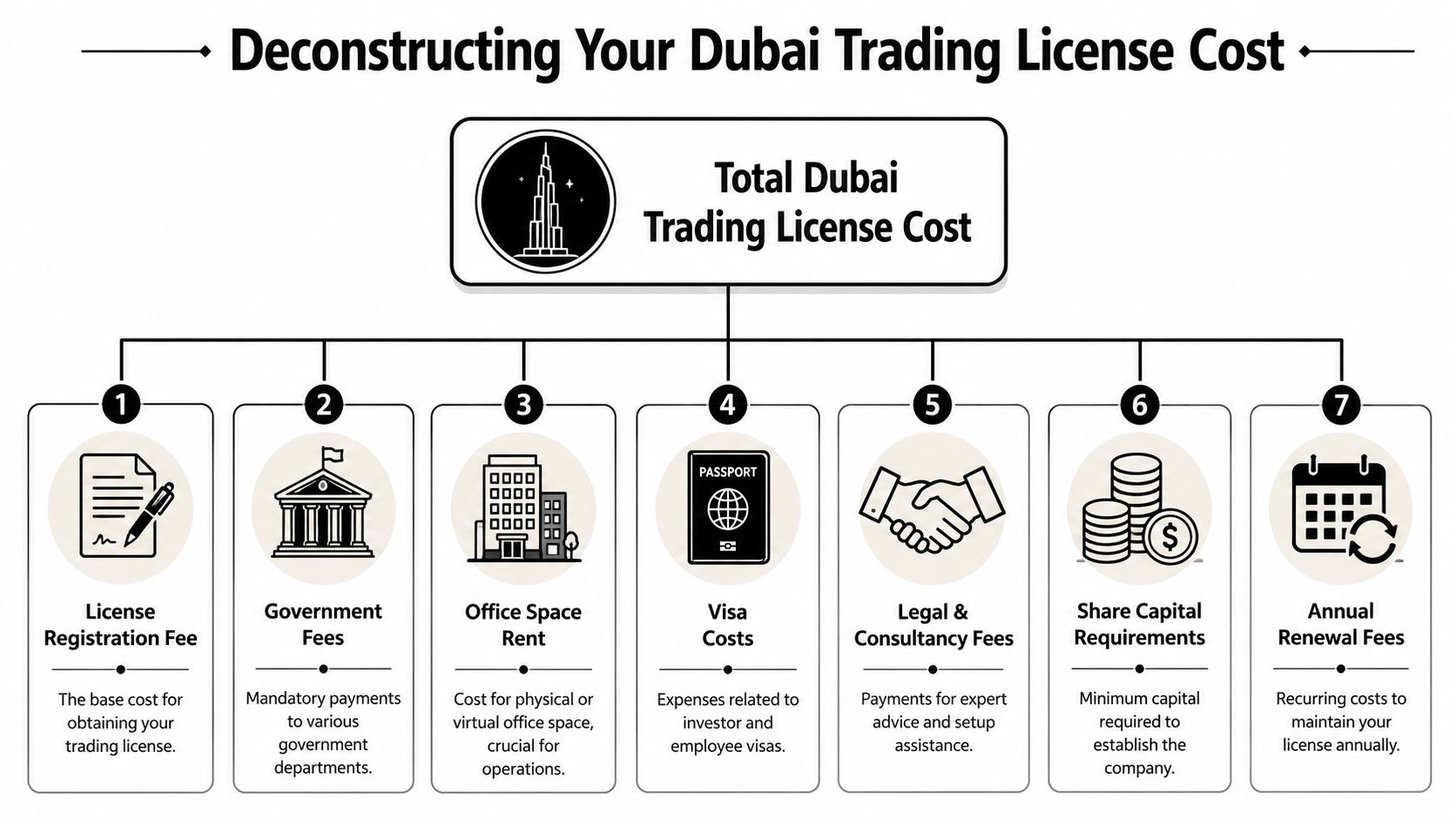
The Licence Is Only One Part of the Full Setup
Many founders focus only on the line marked “licence fee.” That is understandable but it only tells part of the story.
The total cost of setting up a business in Dubai is shaped by several connected decisions, and changing one part often affects another.
For example, adding visas may require a larger office package. Changing the business activity may trigger extra approvals. Moving from a free zone to mainland can improve local market access, but it often increases compliance responsibilities and operating costs.
This is why the final budget is rarely as simple as the first quote suggests.
For more technical or specialised business activities, these differences become even clearer. Market estimates for technical services licences, for example, often range from AED 11,900 to AED 30,000 depending on the setup model. In many cases, visa costs can add AED 3,000 to AED 5,000 each, while office or Ejari requirements may add another AED 5,000 to AED 20,000 annually.
These examples show how quickly the real cost can move beyond the licence itself.
The Main Factors That Shape Your Final Cost
In most cases, seven factors determine the actual setup cost.
Jurisdiction
Mainland, free zone, and offshore structures all serve different purposes. Mainland is often better for direct UAE market access. Free zones usually reduce barriers for international trade and service-based businesses. Offshore structures are specialised and not designed for regular operating businesses.
Business activity
“Trading” is not one single category. General trading, e-commerce, technical services, consultancy, and regulated sectors all follow different approval paths and pricing structures.
Company structure
The number of shareholders and the chosen legal form can affect documentation, approvals, and how the business is viewed by banks or commercial partners.
Office or workspace
This is one of the biggest variables in many budgets. A flexi-desk setup and a full leased office create very different cost levels and visa capacities.
Visa requirements
Investor and employee visas add direct government and processing fees. They can also affect the type of office or facility your business must maintain.
Additional approvals
Certain activities require external approvals beyond the core licence before the company can start operating.
Bank account readiness
Opening a bank account is not just a final step. It often depends on having the correct activity wording, a clear business model, complete documentation, and a company structure that aligns with real operations.
The practical takeaway is simple: your budget should cover both setup and usability.
If you only budget for the licence issuance, you have not fully budgeted for the business.
| Cost driver | Why it matters |
|---|---|
| Jurisdiction | Determines market access, ownership framework, and compliance path |
| Activity | Affects licence class and possible external approvals |
| Premises | Influences issuance, renewal, and visa capacity |
| Visas | Adds both direct fees and operational obligations |
| Banking readiness | A weak setup can delay account opening even after licence issuance |
Mainland vs Free Zone: A Strategic Cost Analysis
The decision between mainland and free zone is not really about choosing the cheaper option. It is about selecting the structure that best supports how your business will operate both on day one and as it grows over time.
A lower-cost setup can still become the wrong choice if it restricts your market access, limits operations, or forces expensive restructuring later.
Mainland companies are usually the stronger choice for founders who need direct access to the UAE market, local contracts, and fewer trading limitations. That wider access often comes with higher setup and compliance costs, but for businesses built around local revenue, the additional investment can be justified.
Free zone companies, by contrast, often offer a more cost-efficient entry point and a simpler setup process. They tend to work well for service-led businesses, international trade models, and founders who do not need immediate access to the mainland market. But the lower setup cost can come with practical limits depending on the business activity and long-term growth plan.
The real comparison is not just about price. It is about access, flexibility, compliance, and future scalability.
A founder planning local retail, contracting, or direct UAE client work will measure value very differently from someone running exports, remote consulting, or a digital-first business.
That is why the better question is not “Which is cheaper?” but “Which structure gives my business the right commercial access at the most sustainable cost?”
.
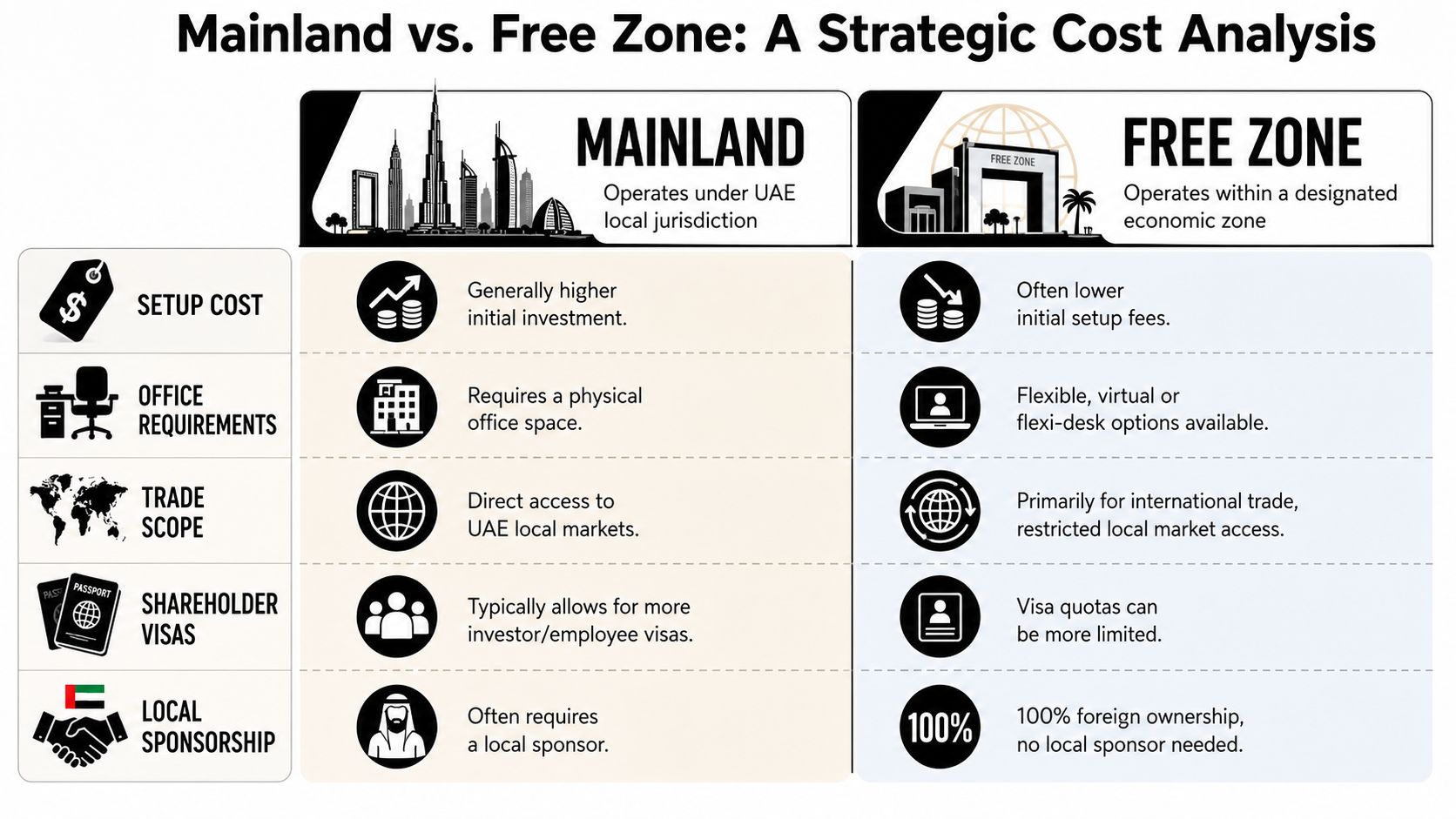
Choose Based on Revenue Model, Not Brochure Pricing
If your business relies on trading directly within the UAE, dealing with local customers, or building a domestic presence, mainland is often the more practical route. In that case, you are paying for broader access and a structure designed to support local commercial activity.
That usually means more administrative responsibility, but if your revenue depends on local market reach, that extra burden often makes commercial sense.
Free zone structures tend to work better for businesses that are internationally focused, service-based, operating lean, or still testing the market. They are often a cleaner option for founders who do not need immediate mainland trading rights and want a lighter compliance structure while building early revenue.
The decision should always reflect the revenue model, not the lowest visible setup price.
The Right Choice Depends on What You’re Actually Buying
Use this framework when comparing:
- Choose mainland if your customers are based in the UAE, your employees need to work locally, or your business credibility depends on having a stronger domestic market presence.
- Choose free zone if your business serves international clients, operates remotely, values simpler entry, or does not require direct mainland trading rights immediately.
- Avoid choosing on setup price alone if your business model involves warehousing, imports, multiple staff visas, or regular local contracts.
Founders who need local market access but start with the wrong low-cost structure often end up paying twice — first for the initial setup, and then again for the workaround or restructure.
There is also another factor many underestimate: compliance overhead.
Renewals, visa management, office obligations, and banking support all take time and resources. For some founders, this is manageable. For others, it becomes an operational burden they did not budget for.
In many cases, a lower-cost free zone route can be the smarter strategic move if it gives the business room to validate revenue before taking on larger fixed commitments.
Where Offshore Fits
Offshore structures are not usually the right answer for an active operating business in Dubai.
They are generally more suitable for holding companies, asset ownership, and specific international structuring purposes.
If your company needs employees, local execution, client-facing operations, or regular licensed activity inside the UAE, offshore is rarely the practical option.
The framework is simple:
Pay for access when your business genuinely needs it — and avoid paying for operational capacity you will not use yet.
Sample Cost Breakdowns: A Realistic Budget View
What looks cheap on paper can often become expensive in operation.
A realistic Dubai trading licence budget should separate three things clearly:
- Licence issuance cost
- Activation cost
- Annual carrying cost
This is where many founders underbudget — especially on visas, office space, immigration file setup, and the practical steps required to make the company fully operational after the licence has been issued.
The figures below are planning examples, not fixed market prices. Their purpose is to show where costs typically increase beyond the initial licence fee.
Scenario Comparison Table
| Cost Item | Scenario 1: Free Zone E-commerce (1 Visa) | Scenario 2: Mainland Professional Services (2 Visas) |
|---|---|---|
| Core licence | Usually sold as a package with the authority's base approval and licence issuance | Starts with the government issuance layer, then adds structure-specific requirements |
| Registration and incorporation | Often bundled, but not always. Check whether incorporation documents and establishment card work are included | Usually split across several steps, with more room for third-party drafting and attestation cost |
| Trade name and approvals | Sometimes absorbed into the package | Often easier to see as separate government charges |
| Premises | Flexi-desk or shared desk is common at launch | Physical office commitment carries more weight, especially once staff count rises |
| Investor or partner visa | Add one visa if the founder needs residency | Add investor or partner visas based on shareholder structure |
| Employee visas | Can be deferred if the business starts solo | Two visas create a meaningful jump in immigration, medical, Emirates ID, and quota-related spend |
| Establishment and immigration file | Post-licence cost that many low-entry quotes leave vague | Required for visa processing and usually more central to the operating plan |
| Bank account preparation | Lower document burden in some cases, but still subject to bank review and business substance questions | Usually needs a clearer local business case, stronger documentation, and more founder time |
| Operating logic | Lower entry cost if sales are online and mostly cross-border | Higher setup and running cost, but better fit for direct UAE client work |
What these budgets usually look like in practice
Scenario 1: Free Zone E-commerce (1 visa) suits a founder who wants to start lean, test sales, and avoid taking on office overhead too early. The upfront package may look attractive, but the key question is whether it includes enough visa capacity, acceptable workspace rights, and support documents for banking. If those items sit outside the quote, the launch budget rises fast.
Scenario 2: Mainland Professional Services (2 visas) suits a business that expects to sell inside the UAE from day one, hire early, and present a stronger local operating profile. The licence is only one part of the bill. Office commitment, immigration file activation, and staff-related processing can quickly become larger than the initial government charge.
That is the trade-off. Free zone often lowers entry cost. Mainland often lowers commercial friction if the revenue model depends on the local market.
How to read a quote without getting misled
A usable quote answers practical questions, not marketing ones:
- What exact activity is covered
- How many visas are included, and how many are only possible later
- What type of premises is attached to the licence
- Which post-licence steps are excluded
- What the first renewal year is likely to cost
I tell founders to test every quote against one standard. Ask what it will cost to get the company licensed, resident-capable, bank-ready, and able to invoice. That is the actual budget. The licence fee alone is only the entry ticket.
From Application to Activation Your Setup Timeline
The licence is rarely the point where a business becomes usable. Operational readiness usually takes longer and costs more than founders expect, especially if visas, banking, and premises approvals sit on separate tracks.
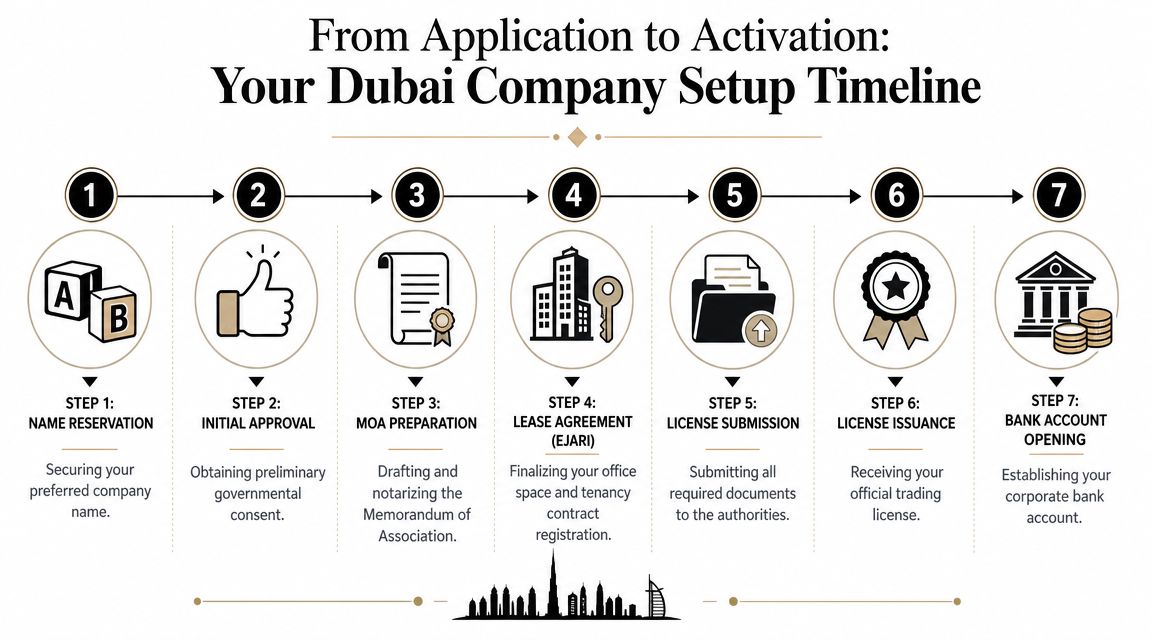
When costs usually become payable
Setup costs tend to arrive in phases, not as one clean invoice. That matters because each step can trigger the next spend decision before the company is fully ready to trade.
- Name reservation and activity selection. Cost discipline begins here. If the activity is chosen too narrowly, the company may need amendments later. If it is chosen too broadly, compliance and approval complexity can increase.
- Initial approval. The authority confirms the structure can proceed. This is still a pre-operational stage, but money has already started going out.
- Constitution documents. Formation documents are prepared, reviewed, and signed. For some structures, founders also deal with notarisation, attestations, or bilingual paperwork.
- Premises commitment. Any required desk, office, or lease commitment usually appears here. This is often the point where a low-cost setup begins to look more expensive in practice.
- Final licence issuance. The company legally exists, but it may still be unable to hire, sponsor, or bank.
- Establishment card and immigration file opening. These steps convert the licence into something that can support residency processing.
- Visa processing, status change, medical, and Emirates ID. Founder and employee activation costs usually start stacking up here, not at the licence stage.
- Corporate bank account opening. This can run alongside the licensing process, but approval often depends on having the right documents, business profile, and operating substance.
What slows activation in real cases
The timeline is rarely delayed by the licence itself. Delays usually come from document mismatch, office evidence, missing shareholder paperwork, or a bank asking for more commercial background than the founder planned for.
That is why I advise clients to map two timelines, not one. The first is legal formation. The second is commercial activation, meaning the point at which the company can receive funds, process visas, sign contracts, and invoice without workarounds.
A practical timeline review should answer four questions:
- When is the company legally formed
- When can the investor visa process start
- When can staff be sponsored
- When is the business realistically bank-ready
Those dates are not always the same.
Plan for working capital, not just formation speed
A fast approval has limited value if cash gets trapped in the wrong stage. Founders relocating to Dubai often spend on the licence first, then realise they still need liquidity for deposits, visa steps, medicals, ID issuance, and early office or flexi-desk commitments before revenue starts.
The smarter approach is to budget from application to activation. That gives a clearer view of total setup drag, not just the cost of getting the trade licence issued.
Beyond the Initial Quote Hidden Fees and Annual Costs
The cheapest quote often produces the most expensive setup.

The initial price rarely reflects the operating reality
A trading licence quote usually shows the formation layer, not the full cost of getting the business ready to trade. The gap appears later. Attested documents, legal translation, immigration file opening, medicals, Emirates ID issuance, banking support, customs permissions, and office commitments are often treated as separate items.
That does not always mean the quote is misleading. It usually means the scope is narrow.
The practical question is different. What will it cost to form the company, activate it properly, keep it compliant, and renew it without friction next year?
That is the number founders should compare.
A low entry price can still be the wrong decision if the structure creates heavier annual overhead. I see this most often with businesses that need multiple visas, physical space, import-export permissions, or a bank account that requires stronger substance. The licence fee may look competitive. The operating burden is where the significant difference shows up.
Hidden costs usually sit in four places
Founders should pressure-test any proposal against the items below before approving it.
- Visa-related costs. Entry permits, status change, medical testing, Emirates ID, visa stamping, and immigration file charges can add up quickly, especially once dependants or employees are involved.
- Premises costs. A flexi-desk package and a business that needs actual office space are priced on completely different assumptions. Deposits, Ejari, fit-out, and renewals may sit outside the headline quote.
- Banking readiness costs. Bank account opening is not a government fee, but it affects the actual setup budget. Founders often need business plans, profile decks, transaction evidence, or advisory support to get the account approved.
- Operational permissions. Customs registration, product-specific approvals, municipality requirements, and other activity-linked clearances can sit outside the licence itself.
This is why I tell clients to stop asking, "What is the licence cost?" and start asking, "What does this company structure cost to run?"
Annual cost decides whether the setup stays workable
The first-year invoice gets attention because it is visible. The renewal cycle is what tests whether the setup fits the business model.
Some companies can absorb extra overhead because margins are strong and the UAE entity gives them better access to customers, suppliers, or logistics. Others should keep fixed costs tighter because revenue is seasonal, hiring will be gradual, or the company is using Dubai mainly as a regional base.
That trade-off matters. Market access has a price. Compliance has a price too.
If the business needs direct UAE trading flexibility, the right answer may be a structure with a higher recurring cost. If the company can operate effectively with lighter premises and fewer visa obligations, a leaner structure often protects cash flow better.
Low setup cost is useful. Low annual drag is what protects the business.
Use this checklist before signing off on any quote:
- Confirm the visa count used in the proposal. Zero-visa pricing is common and often irrelevant to the actual plan.
- Confirm the office assumption in writing. Shared desk, private office, warehouse, and showroom setups carry very different renewal obligations.
- Confirm what happens after licence issuance. Ask whether immigration setup, employee onboarding support, and bank account assistance are included or excluded.
- Confirm the renewal basis now. Some packages look light in year one and become expensive once standard renewals, premises upgrades, or added compliance steps begin.
A short explainer on common setup misconceptions is worth reviewing before you commit:
Your Dubai Trading Licence Cost Questions Answered
Do I need a physical office?
Sometimes yes, sometimes no. It depends on the jurisdiction, activity, and visa plan. Some setups can start with flexible workspace solutions. Others need a leased office because the structure, market access, or visa capacity requires it.
Why do two quotes for the “same” licence look so different?
Because they usually aren't quoting the same thing. One may show only the authority issuance layer. The other may include premises, immigration setup, and support services needed to make the company operational.
Is the lowest-cost jurisdiction always the smartest choice?
No. If the company needs direct UAE market access, local contracting flexibility, or several visas, the lower entry cost can become a poor strategic fit.
How should I compare proposals?
Ask for a line-item breakdown. You want the activity, jurisdiction, visa count, premises requirement, post-licence steps, and renewal assumptions clearly stated in writing.
What's the best way to get an accurate quote?
Give the advisor your real operating plan, not just the activity name. Include where your customers are, whether you need local sales, how many people need visas, whether you'll hold stock, and what kind of office footprint you expect. That's the only way to calculate Dubai trading license cost properly.
If you want a personalised cost proposal instead of a generic package, Inpro Corporate Services L.L.C. can map your setup by jurisdiction, activity, visas, banking needs, and ongoing compliance so you can see the actual total cost before you commit.